
Changing environmental conditions and rising heating and cooling costs make energy efficiency an essential consideration for every building.
By replacing six old frames in a 100 m² apartment with modern thermal aluminium systems achieving a Uw value of 2 W/(m²K), annual heating and cooling savings can reach up to €1,000.
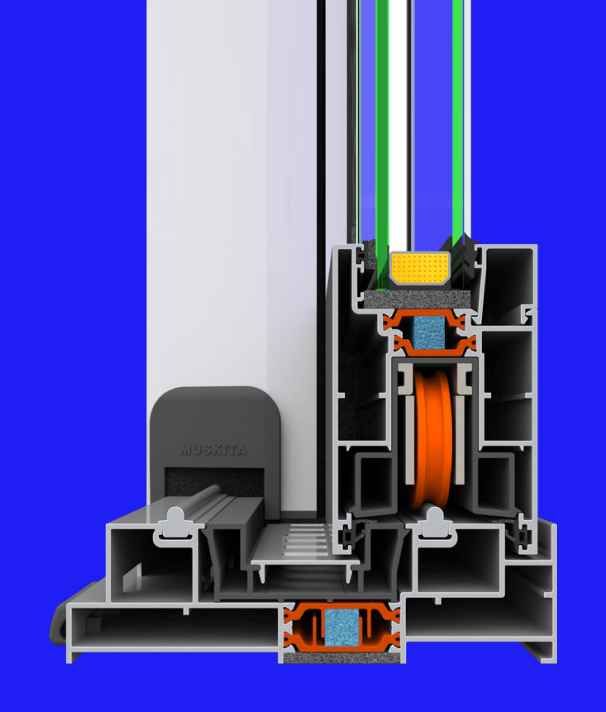
A thermal aluminium system prevents energy (heat or cold) from being transmitted from the outside to the inside of your home or vice versa. Good insulation rates and sound reduction are achieved by placing a polyamide (a poor conductor of heat) between the outer and the inner surface of the profile, which acts as a thermal break.
Thermal transmittance or the U-Value, is measured in W/(m²K) and is the amount of heat per unit time that can penetrate a square meter (1 m²) of construction material (e.g. frame) with a thickness d (m) over a period of one hour, when the temperature difference between these surfaces (inside vs. out) is equal to 1 degree (1°C).
U-values measure how efficient a material is as an insulator. Lower U-values indicate lower thermal loss and more insulation provided by the material.
The following values are needed in order to calculate the overall U-value coefficient of a frame, otherwise known as Uw or U-window:
- Thermal transmittance of the glass (Ug - “glass”)
- Thermal transmittance of the frame (Uf – “frame”)
- The type of the glass spacer (“spacer”)
- Percentage of frame area relative to the total frame area
The Uw (U-window) is calculated by the following equation:
Uw = (ΣAg × Ug + ΣAf × Uf + Σlg × Ψg) / (ΣAg + ΣAf)
Where:
- Ug is the Thermal transmittance of the glass
- Uf is the Thermal transmittance of the frame
- Ψg is the linear heat transfer for different spacers
- Ig is the perimeter of the visible glazing frame
A low Uf value is important when selecting an aluminium system. However, because glazing occupies the largest surface area of most windows, the Ug value of the glass can have an even greater effect on overall performance.
Using glass with a lower Ug value can significantly improve the total Uw value of the window.
For an accurate comparison between aluminium systems, compare their Uf values or calculate their Uw performance using the same glazing specification and window dimensions.
Glazing Thermal Transmittance Values:
| Type of Glazing | Glass Thickness, Gap, Air Type | Ug W/(m2K) |
|---|---|---|
| Single Glazing | - | 5,7 |
| Double Glazing (without coating - standard glass paint) | 4-12-4, air | 2,8 |
| Double Glazing (without coating - standard glass paint) | 4-12-4, argon | 2,7 |
| Double Glazing (without coating - standard glass paint) | 4-16-4, air | 2,7 |
| Double Glazing (without coating - standard glass paint) | 4-16-4, argon | 2,6 |
| Double Glazing (with coating on one side) | 4-12-4, air | 1,6 |
| Double Glazing (with coating on one side) | 4-12-4, argon | 1,2 |
| Double Glazing (with coating on one side) | 4-16-4, air | 1,3 |
| Double Glazing (with coating on one side) | 4-16-4, argon | 1,0 |
| Double Glazing (with coating on one side) | 4-12-4, krypton | 1,0 |
| Double Glazing (with coating on two sides) | 4-10-4-10-4, air | 1,1 |
| Triple Glazing (with coating on two sides) | 4-10-4-10-4, argon | 0,8 |
| Triple Glazing (with coating on two sides) | 4-12-4-12-4, air | 0,9 |
| Triple Glazing (with coating on two sides) | 4-12-4-12-4, argon | 0,7 |
| Triple Glazing (with coating on two sides) | 4-16-4-16-4, argon | 0,7 |
| Triple Glazing (with coating on two sides) | 4-16-4-16-4, argon | 0,6 |
| Triple Glazing (with coating on two sides) | 4-16-4-16-4, krypton | 0,5 |
Frequently Asked Questions.
Using non-insulated aluminium systems, consumes up to 40% more energy for heating and cooling. By choosing thermally insulated aluminum systems you can avoid wasting energy and therefore save money.
In energy efficient thermal systems, the outer aluminum profile is separated from the inner profile by polyamides that thermally break the profiles, leading to excellent energy savings for both heating and cooling. Polyamides are visible on the side of the sash, so you can confirm that the frames you have in your home are thermally insulated.
If you have decided to change your aluminium systems, it is advisable to replace the entire frame. Don’t just change the glass of existing non-insulated frames. Aluminium as metal is good conductor of heat, therefore, changing only the glazing will lead to condensation of water vapor on the inside of the glass created by the temperature difference from inside to outside. The solution to this is to use thermally insulated aluminium frames.
In order to achieve maximum thermal insulation, it is vital to choose energy-efficient glass panes. Glazing takes up the largest surface area of the frame and must be chosen carefully. Our aluminum systems cover all possible frame configurations, including triple glazing, ensuring excellent energy efficiency, sound reduction and safety.
When installing thermal aluminium systems, specialised sealing gaskets and plugs must be placed around the frame, between the flooring and masonry. This prevents the loss of heat or cold and preserves the thermally insulating properties of the system. In addition, all joints must be sealed with silicone.
Your aluminium fabricator can inform you about the thermal coefficient of the system you have chosen. At MUSKITA we can also help you evaluate your system's heat transfer coefficient with our state-of-the-art thermal cameras.
Tell us what you’re building or upgrading, and we’ll point you to the right solution.